

10 Books That Shaped Me
Like a great song or movie, books open us up to new ways of thinking and being.

Hi Friends,
Today I’m writing about a subject that’s near and dear to my heart: Books.
Books can change your life. For twenty dollars or less, a single book can significantly influence and change who you are as a person. Like a great song or movie, books open us up to new ways of thinking and being. And like the best works of art, great books get better with age, fostering our continued growth, knowledge and curiosity with each read.
I wasn’t always a reader but as far back as I can remember I’ve been drawn to books. I learned to love reading, thanks to the books that helped shape me. Today, I have a hard time passing a bookstore without stopping to pick up a new book, so my shelves are always filled with new books to read. I try to read widely but I enjoy following my gut and reading what sparks my interest.
I’ve read each book on this list countless times (with one exception). Some I’ve read more recently than others, some I read during my formative years as a teenager. All of them hold a special place in my life for what they taught me about the world and myself.
10 Books That Shaped Me
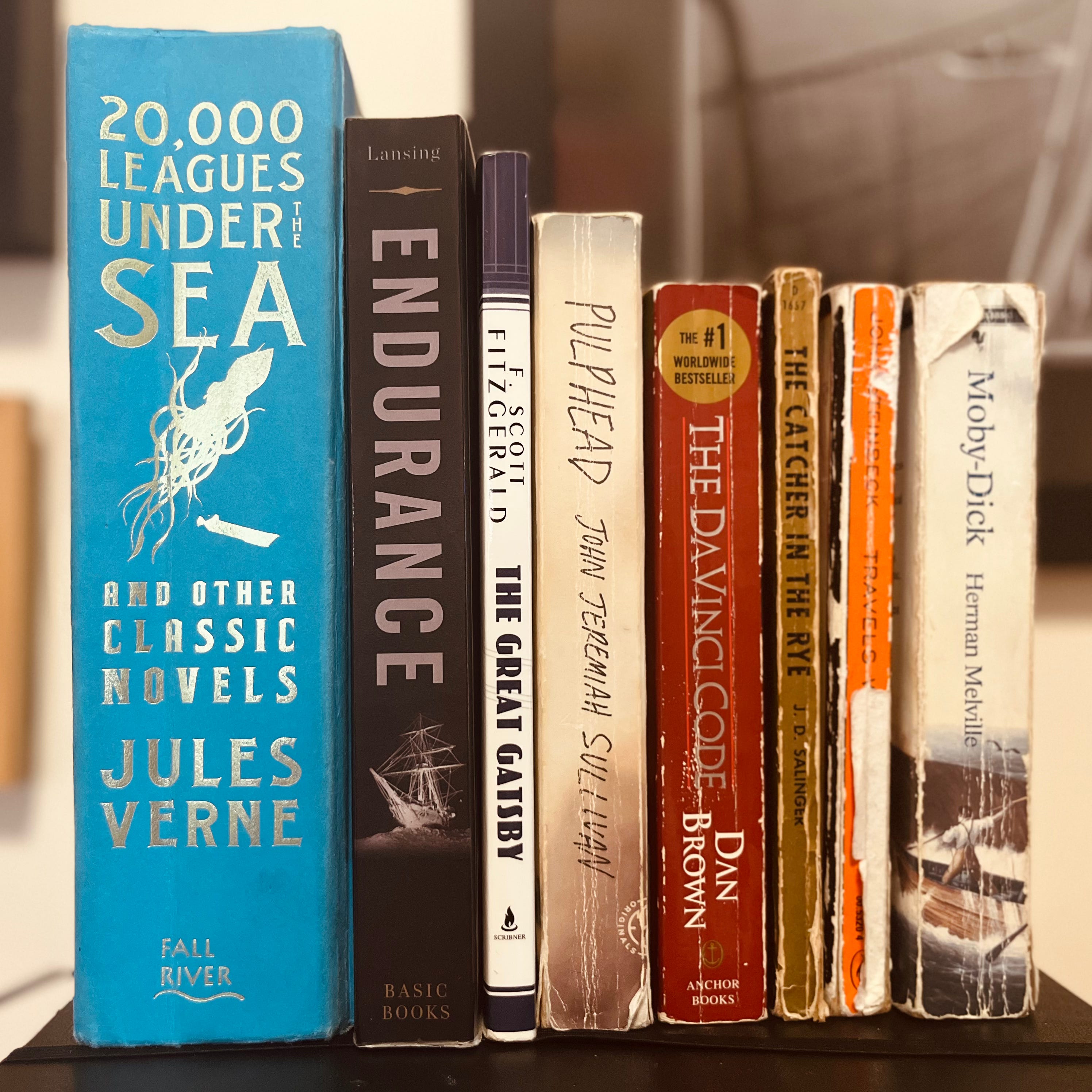
20,000 Leagues Under The Sea, Jules Verne. Disney’s film adaptation led me to this Jules Verne classic. As a kid, I remember finding the book in the library and marveling at the biological terminology of the sea’s aquatic life. This was a tough book for me to read at a young age but I felt a deep sense of accomplishment when I finished. I re-read this book a few years back before a trip to Nantes, France where Verne lived and wrote.
Basher Five-Two, Scott O’Grady and Michael French. I bought this book at a middle school book fair and I was immediately hooked. American F-16 fighter pilot Scott O’Grady’s describes his harrowing account of getting shot down over Bosnia in 1995 and successfully evading capture until rescue arrived. I read this book until it literally fell apart and it’s directly responsible for my love of thrillers, especially those involving the military and geopolitics. (The 2001 film Behind Enemy Lines is based on O’Grady’s experience).
Catcher In The Rye, J.D. Salinger. I first read Catcher in my early teens and then several times throughout high school. I suppose I had a similar experience to many people who’ve read this book at that age, but Salinger put into words what I’d been feeling in a way that other books I read hadn’t. I haven’t read this one in many years and having learned more about Salinger and the book’s history, I’m curious to re-read it.
The Great Gatsby, F. Scott Fitzgerald. This was assigned high-school reading for me but for good reason - I think it’s one of the best novels ever written. I still read this one almost every year, especially when the weather in New York City gets hot and humid and I begin to feel like Nick sweating on the train to Manhattan (“Hot, Hot!”). I’m struck by Fitzgerald’s writing with each read.
Da Vinci Code, Dan Brown. If you happen to despise Dan Brown, you’re probably wondering why this one is on my list. I went to a Catholic high school and this book came along right when I was beginning to question the world around me, including religion and God. One morning on a bus ride, I overhead two older students talking about a book with secret knowledge, hidden symbols and codes. I knew had to read it, and I was hooked once I did. Brown blends complex questions into an entertaining thriller that opened my mind at the perfect time.
10 Ways To Love Reading
·
Do you want to read more but don’t have the time? Or haven’t found a book that really grabs you? Here's 10 Ways To Love Reading.
Desert Solitaire, Edward Abbey. Another book I read during high school while on a road trip to Arches National Park where Abbey was a park ranger. Not only was this book a perfect companion for exploring the desert but it was also a completely new way of writing that I was unfamiliar with at the time. The book is part memoir, part collection of essays on environmentalism, nature, and a whole lot more. This is as much a philosophy book as it is a book about nature, and Abbey can describe the setting sun as well as he can dissect what’s wrong with modern society.
Travels With Charley, John Steinbeck. Over the past few years, I’ve re-read this classic each summer, usually while on a trip. I used to think of it as just a roadtrip book, but it is far more than that. Steinbeck uses the trip as a way to explore American identity in the early 1960’s and confronts the major issues of the era, namely the civil rights movement. Steinbeck is a master and I learn something new with each read.
Endurance, Alfred Lansing. One of the first books that taught me history and non-fiction can be both enlightening and entertaining. This is the definitive account of Ernest Shackleton’s ill-fated Antarctic expedition in which his ship Endurance became stuck in ice, forcing Shackleton and his crew to travel hundreds of miles to the nearest outpost. The best part? Everyone survived. This is what makes Shackleton one of the greatest leaders in history.
Pulphead, John Jeremiah Sullivan. I found this book at a free library sometime between 2017 and 2020 and I was floored by the writing. Sullivan’s early magazine writing, covering everything from Axl Rose, to the Real World, to Unnamed Caves, carries the torch of gonzo, using the essay form to distill an idea or experience down to it’s roots with humor and an exacting attention to detail. I find myself coming back to this book every few months, and currently I’m deep into The Last Wailer, Sullivan’s interview with Bunny Wailer. I love listening to this book even more than reading because as Sullivan reads his words, you get a better understanding of his sense of humor and the extremely well-written prose.
Moby-Dick, Herman Melville. I struggled to read this one through most of 2024 but once I finished I realized why it’s one of the best American novels ever written. This book changed my idea of what a novel can be. Melville wrote an historically accurate account of the whaling industry couched within a narrative about a one-legged captain hell-bent on killing a white whale. The best part is that the whale is based on a true story. I’m looking forward to reading this one again soon.

In writing this list, I realize that I value books that I can read over and over again, that make me think, engage my curiosity and my (sometimes obsessive) desire to learn everything I can about a topic. Several of these also contain an adventure or journey so clearly I enjoy reading about overcoming obstacles or discovering one’s self while on a trip through the world or one’s own mind. (I also really like stories about the sea!) These books also came to me at formative times in my life, including my teen years.
These are the books that shaped me. Now I want to hear from you: Name one book that shaped you and why.
Thanks for reading! If you haven’t already, please subscribe for more writing.
You can also Buy Me A Coffee to help support Circles In Space.
Until next time,
Keith
Great list! For me, it was The Hatchet by Gary Paulsen, a book a read as a teenager. About a boy on a small plane that crashes in the wilderness and he is forced to survive on his own with nothing but a hatchet. I always remembered it as the first book that I couldn’t put down and that made me want to read more.